Showing posts with label Versailles. Show all posts

Monday, October 2, 2017

Dopey Prince Charles, Slutty Minette and Other Disastrous Stuarts: On Why They Can’t Replace The Tudors


Ever since “The Tudors” ended in 2010, producers have been trying to find a royal family that can fulfill an audience’s craving for dysfunctional bluebloods. An article by Elizabeth Fremantle, a renown historical fiction author, got me thinking if the Stuarts could be the new trend. I happen to love the Stuarts, but I must display skepticism at such elevation.  Judging by contemporary period dramas, they were not exactly the most exciting or most positive royals around. One tremendous example is what Starz “Outlander” (and Diana Gabaldon) have done with Bonnie Prince Charlie, the most famous and charming of the Stuart family.

While preparing for the third season of “Outlander,” I decided to watch earlier episodes.  I was struck by the tragic Jacobite devotion for The King over the Water. On the first season, Claire is mystified by this readiness to die for a king that she knows was undeserving. After we catch a glimpse of the real item, viewers share her impression. In books and series, Bonnie Prince Charlie is shown as a selfish dunce, but that is how historical fiction perceives the Stuart overall, some bunch of useless idiots. I cannot see them ever replacing the Tudors.

Stuartmania vs Tudormania?
To replace Tudormania with Stuartmania, writers and producers would have to wipe our minds clean of any preconceptions and misconceptions dealing with the regalest of Scottish clans. Michael Hirst, Philippa Gregory and Hilary Mantel were the architects of the second and more everlasting wave of Tudor fascination but they had to work their heads off rewriting historical facts and characters and making them palatable to the public.

History tells us Henry VII, founder of the Tudor dynasty, was a tyrant, and usurper, and a greedy man. In comes Pippa Gregory and turns him into a frightened young man who stands king only through the joint efforts of his formidable mother and his little York wife. In Starz’s crazy adaptation of “The White Princess” Queen Lizzie became a badass and a black hearted dominatrix, bent into making her monster children the future rulers of England.

The White Princess and her king

We all know Henry VIII was a fat satyr, a wife-murderer, and a despotic king, but modern historical fiction gives us a thin and brooding tragic hero. His daughter, Bess, who was a distrustful, neurotic bully has been transformed into a cross between a British Madonna (the Virgin Mary not the former Mrs. Guy Ritchie) and Spencer’s idealized Fairie Queen. Even her sadistic sister, in “The Tudors,” falls into the wronged little princess stereotype, the Sansa Stark of Henry’s Court.

No such treatment has befallen on the Stuarts.  There is always Mary, but let’s be honest, there was more Guise and Tudor in the genes of the Queen of Scots, than Stuart wishy-washiness. She was French born, and French bred, had no understanding of Scotland, and no cultural links to the British Isles.
Mary's happiest years were in France

Dull King James and the Two Charles
 And yet, once the Stuart princes projected a glamorous image on the silver screen. David Niven in kilt was a proud and gallant Bonnie Prince Charlie, and a fantastic dashing Sam Neill was his uncle Charles II in lovely “Restoration.” It’s the Third Millennium which has taken the Stuarts to task by conferring them infamous fame. The family is well represented in current television series, and some films as well, but none of these Stuarts kings (or their kin) can muster up the same allure mad Tudors exercise upon us.
Sam Neill as Charles II

 Poor King James who united England and Scotland, has only shown his face in two recent dramatizations. In “Gunpowder: Love and Treason” he was played by the ever-competent Robert Carlyle, but something went wrong. Carlyle, fresh from his starring role in “Hitler,” enacted James as if the actor was still in a brown shirt. The king came across as a paranoid tyrant, not a man who would rewrite the Bible.
Tormented King James and his Danish queen

Jonathan Pryce also played Mary Stuart’s only son in “The New World,” but he was overshadowed by a steamy triangle where Colin Farrell and Christian Bale fought for the hand of lovely maiden Pocahontas.  We as public have yet to know the factors that made King James interesting. None of those films showed his remarkable knowledge, his literary patronage, his witch-hunting, or his bisexuality.

So much for James, then comes his poor beheaded son. Rupert Everett was a decent Charles I, in the film “To Kill a King,” but he seemed a bit dazed perhaps because there were so many historical inexactitudes in that account. Also, because Tim Roth, impersonating a bloodthirsty Cromwell, was bent to chew the scene to the point that he climbed to the scaffold with the king. For a moment, I thought he would chop off Charles’ head. He could have, since in real life, the two official hangmen of the reign refused to commit regicide. To this day, nobody knows who decapitated Charles.

Rupert Everett and Tim Roth, on the scaffold, in "To Kill a King"


The martyred king was again decapitated in the rather dull ITV miniseries “The Devil’s Whore,” where he was played impeccably by Peter Capaldi in his pre-Dr. Who stage. And that is the extent that we get to know about poor beheaded Charles whose sole purpose in life seems to have begotten the flamboyant Charles II. But even the executed king’s son has merited a dull treatment.

Taking advantage of the public’s appetite for royal affairs, the BBC, in 2003, decided to gift us with “Charles II: The Pride and the Passion.” Despite its bombastic title, it was a tepid affair. Not even charming Rufus Sewell could lift that sinking weight. To add insult to injury, the series was cut, chopped, butchered, in the clumsiest manner, so American audiences got to watch a fragmented and confused tale.

Still, Charles II is too good material to waste. In 2004, Rupert Everett, who likes to play kings and charming princes, went on to portray old King Charlie in “Stage Beauty.” As his was a secondary character, we tend to remember that he slept with Nell Gwynn (Zoe Tapper) more than any other kingly things he performed. A much more prominent role was given to John Malkovich in “The Libertine.” Obviously, Malkovich was out staged by Johnny Depp who can out stage a giant kraken, but oddly the king seemed more destructive than his friend and protégé, the infamous Earl of Rochester (Depp). Charles came out as a self-serving, incompetent monarch. Rochester had to drag himself on crutches (and with a face corroded by syphilis) to save his king from Parliament. How torpid can a sovereign be to need that?

That is the image Charles II, and other Stuarts, on the rebound, project on films obviously made by anti-monarchists. Just think of Jeremy Northman in “New Worlds” (I loved his wig, though), Jack Huston in “The Great Fire,” or Daniel Lapaine in “Versailles.” I haven’t seen Charles Dance in the Dutch film “Michel de Ruyter,” but I can bet money that he is not a positive Charles. If the sexiest of the Stuarts gets bad press, what is left for the others?

The Stuart Queens
Charles had a brother, James, but not even his subjects loved him and had him replaced by Mary, his Protestant daughter, whom I have yet to see in any piece of fiction. Oh, wait, "Versailles" showed her on the first season’s finale. A little girl that is offered to William of Orange as a future bride.  Aside from the fact that Maryland was named after her, what do we know of this Queen Mary?  She was barren, had a crush on a girlfriend when she was young and her husband was supposed to be gay. Maybe something could be done with that. 
"Queen Mary and William of Orange

Her sister Anne, who was also a queen, made a career giving birth to dead babies, had chairs named after her, and was totally under the thumb of her favorite lady-in-waiting, Sarah Churchill. Soon we are to see Anne played by Olivia Coleman in “The Favorite,” but in this incoming film, all the action will be centered around Sarah (Rachel Weisz). That is the rub with Queen Anne, she matters only as patron-friend-bitch of the Duke of Marlborough’s wife.

The “Bonnie” Prince
We should go back to rejected king James II  to find a Stuart with an ounce of charisma. Not old James—he comes across as a true monster in literature. Victor Hugo makes him the mastermind behind the deformity of his protagonist, in The Man Who Laughs. By James’ royal whim poor Captain Blood is sold into slavery. We do not need to hear more of James, it’s his grandson who matters, the charmer in the family, the aptly named “Bonnie” Prince Charlie.

The real Charles James Stuart

Bonnie and charming he was in literature, especially in Sir Walter Scott’s novels, or played by Ivor Novello in the silent cinema or David Niven in the talkies. Thanks to those works, I had a romanticized vision of this unhappy prince and his lost Jacobite Cause. It was hard for me to reconcile him with what the historians told me, that he was a petulant stubborn man, who neglected his illegitimate children, raped his wife and led thousands of his subjects to death or misery. Nevertheless, that was the vision “Outlander” spouses. Diana Gabaldon really dropped the bomb on Charles Stuart, and the series echoed her scorn for the Young Pretender.


In the second season of “Outlander,” time traveler Claire and her husband Jaime Frazer decide that the only way to save Scotland from the tragedy of Culloden is to ensure that battle will never happen. They travel to France to thwart Charles Stuart’s plans to travel to Scotland. Through the ministrations of his cousin Jared, Jamie gets an audience with the Bonnie Prince, but since Charles is living incognito, they meet at the most unlikely of places, a brothel.

The setting foreshadows the Prince’s appetites, his lust, and frivolous and irresponsible nature. Charles is charming and not stupid, but he is also naïve and rather cutout from reality. He displays dismissive arrogance with Murtagh (who is escorting his godson) and is angry at Jamie when he is not told what he wants to hear.

In a way, Charles acts like Daenerys Targaryen in a powdered wig. After demanding that Jamie tells him the truth, he feels offended when young Frazer tells him that the clans are too busy fighting each other to rally behind a pretender to battle the English. However, in a twist that displays his volatile personality the prince praises Jamie’s honesty and patriotism and charges him with getting the necessary funds to finance his enterprise.

Now the Frasers must double their efforts to hinder the upcoming rebellion. It’s an impossible task, the Jacobean Cause does get French support thanks to Bonnie Prince Charlie’s personal magnetism, which appears to be his sole virtue. The Frasers and the public are dismayed since this future king seems to be more into conducting affairs of the boudoir than of states. He is soon involved in a liaison with his sassy married cousin Louise de la Tour D’Auvergne and gets her pregnant.

What horrifies Claire is Charles’ incompetence and his lack of care for both the people and the land he expects to rule. He’s never set foot in Scotland, he knows nothing of his people, and has no interest in learning. He is driven by a sense of mission inadmissible to modern logic. He believes to be divinely anointed, almost as if Melisandre had whispered such notion in his ear. We, historical fiction fans, are used to hear monarchs harping about their divine right to reign, but there is something tragicomic in Charles, an actual Beggar King, making that claim in the middle of a brothel.

This negative portrait of legendary Bonnie Prince Charlie was noted by a public that still saw him as the epitome of Charming (ergo ill-fated) Prince. In an interview in IGN, Sam Houghton, who plays Jamie Frazer, expressed his shock  at learning that a beloved Scottish folk-hero was, in fact,  not very heroic:

“He’s been romanticized in Scotland to an extraordinary degree. The Skye Boat Song is about him, our main theme is about him. There’s pictures of him in Scotland,” Heughan said of Bonnie Prince Charlie. “It’s been romanticized about the great rebellion and his escape, and actually when you look at history you see that he was useless. He was completely ineffectual and led these Highlanders to their doom.”

With this sad portrayal of the selfish pretender, the Stuart Cause was lost. There was no way the public could be galvanized by that royal last name once its most fascinating bearer was outed as a narcissistic idiot. Henry VIII was egotistical and vain, but he won battles, got his women, and ruled his country. Poor Charlie couldn’t rule himself.

Minette, the Silly Slut
Moreover, the same year that “Outlander” pulled down Bonnie Prince Charles from the altar of historical heroes, another show went after another Stuart icon. For centuries, historians and writers have portrayed Henrietta Marie, the sister of Charles II, as a victim; a wronged wife, forced to marry a homosexual, and probably murdered by her husband’s jealous lover. In real life, she who was nicknamed “Minette,” was a hysterical anorexic, an adulteress, and a bad mother to boot.

“Versailles” characterizes Minette as a silly slut, indulging in an affair with her brother-in -law, the Sun King, a relationship that in those days was deemed as incestuous. Played by Swiss actress, Naomi Schmidt, Minette lies, schemes, betrays and breaks the heart of her poor husband.
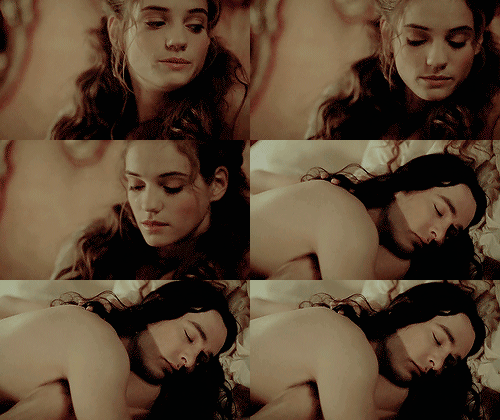
 She also lets her royal lover use her body as well as her mind. He sends her in a secret mission to England to ensure her brother’s support in France’s war against William of Orange. Although in real life, Minette did possess diplomatic skills, in the series she’s seen just like a talking doll delivering her lover’s words to her brother, the King of England. Daniel Lapaine as Charles II didn’t seem very bright either, so we can say “Versailles” did its best to show us the Stuarts as a family of dull morons.

Lesser Stuarts may prove to be more fetching
If the Stuart Kings prove to be less than appealing, we would have to look among their siblings to find stories deserving to be told, for example tragic Arabella Stuart, the Queen of Scots’ niece,  who is the protagonist of The Girl in the Glass Tower, Elizabeth Fremantle’s latest novel.

There is also James Stuart, Duke of Monmouth, Charles II’s illegitimate son who attempted to grab the throne from his uncle and namesake, and ended up losing his head. If you add that Monmouth could have been the real Man in the Iron Mask, you have plenty to work with.

The Duke of Monmouth
The current British monarch, Queen Elizabeth II can trace back her Stuart ancestry to Princess Elizabeth, daughter of the first King James. The Winter Queen, as she was known, could have been queen of England had the Gunpowder Conspiracy succeeded. She made a love match (a rarity in royal families of the time) to Prince Frederick of the Palatinate, became the mother of thirteen children, and was the grandmother of George, first Hanover king of England. Dear Lieselotte of “Versailles” fame was her granddaughter, too. Elizabeth did eventually rule Bohemia, part of modern Czechoslovakia. Alas, her reign was short and sad.
The Winter Queen

I’m fond of Elizabeth of Bohemia, but my favorite Stuart is her son, Prince Rupert of the Rhine, famed military man, inventor, artist, and rumor has it, wizard. He even had a magic dog that died fighting alongside his master. So, it is possible to sell the Stuarts to the public, but only looking beyond their dysfunctional kings. Do you have a favorite among that outlandish royal family?


Saturday, September 9, 2017

Autumn in Period Drama Land: 2017 Fall Schedule


September is here. I never thought I would see another autumn in New York again. It’s such a gorgeous experience. And another gorgeous experience, for us period drama fans, is the cavalcade of historical fiction that will hit  our television screen and our nearby theaters, on this very fall.


Let us start with TV.  September 10, in Starz, marks our get-together with “Outlander”.  It is also a time of meetings in our favorite time-travel tale, when after twenty years of loveless marriage, now widowed Dr. Claire Randall comes across her eighteen-century husband, Jamie Fraser.

To those who have not read Voyager, the novel of which the third season is based, just know that Claire will travel to the past on Halloween. She will reunite with Jamie in Edinburgh, but twenty years have also gone by in Old Scotland. Claire will be less than happy after learning there have been other women and other children in Jamie’s life. The couple will reconcile and travel together to France and finally to the West Indies.

For those of us in the USA, who don’t stream, early autumn would give us the chance to catch up with old favorites and new period pieces. Ovation is bringing us the second season of  “Versailles” (September 30th) and the debut in American TV of ”The Halcyon,” (October 2th).


After Minette’s death, Philippe D`Orleans,  is forced by his sovereign- brother to marry again. How will sweet, down-to-earth, Liselotte of Palatinate put up with a gay husband and his meddlesome lover? That is a question “Versailles” will have to answer. Courtiers are once again rebellious. Royal torturer Fabien Marechal will have his hands full, as he grows closer to girl-doctor Claudine, while spying and being intrigued by devious Madame de Clermont. Meanwhile, his liaison with scheming Madame de Montespan has clouded the King Sun’s intellect. History buffs know that this will lead to black masses, black magic, and black poison in Versailles.


They keep on trying to sell “The Halcyon” as the new “Downton Abbey,” but critics and clips tell me that is hardly the case. Yet as a WWII buff, I can’t stand missing a story about a ritzy London hotel during The Blitz.


On October 1th,  PBS brings us “ Poldark” in his third season. Captain Poldark and devoted Demelza will expand their family in different ways, but jealousy will take a toll on their marriage as Mrs. Poldark gets suspicious of Elizabeth’s premature baby. Dr. Enys will get married, but he’ll spend his honeymoon in a French jail. Ross will have to go to Revolutionary France to rescue his pal. New characters will join this Cornish romance as Elizabeth’s cousins and Demelza’s brothers join their lives.

October the 15th is when we go back to the Greek islands with “The Durrels.”  I haven’t even seen the first season yet, but I saw and loved “My Family and Other Animals” so I know all about zoologist Gerald Durrell’s extravagant yet loving family. To make ends meet, Louisa Durrell takes her children to live in Corfu in the mid Thirties. There, young Gerry grows up unschooled, but learning a lot from the local fauna he collects, and that includes some fascinating humans.


November 23 will face us with the new “Anne of Green Gables.” Since I have decided that the original Anne grew up to become Catherine de Medici, I have no qualms with Ella Ballentine replacing Megan Fellows, in this new version of Lucy Maud Montgomery’s children classic. Oh, and to launch winter and to celebrate Christmas, we’ll get to see the  annual special of “Call the Midwife, ”on December 25th.

We don’t have a date yet, but History Channel keeps on bombarding us with messages that “this fall” we’ll get to meet  “Knightfall.” I’m in a great mood to watch medieval feats, and I’m the first one to sign up for anything dealing with the Templars. Tom Cullen, formerly Lord Gillingham in “Downton Abbey, ” is Sir Landry, a Crusades veteran, bent into finding the Holy Grail, but does he have time to do it? The series is set in the days of Philippe Le Bel, and we all know what that king did to the Order of Knights of the Temple.


Cullen is also playing Guy Fawkes in the BBC baroque drama  “Gunpowder.” The new Targaryen in residence, Kit Harington, will be playing conspirator Robert Catesby who also happens to be the actor’s ancestor. Although it will be a while before we see it in America,  BBC is hoping to have it ready by November for British consumption.


And for us lucky bilinguals, Antena 3 is presenting (hopefully to American audiences too) a new miniseries this fall. “Tiempos de Guerra” (War Times). It takes place in an exotic locale and period, the Rif War,  in 1921. It chronicles the adventures of a bunch of aristocratic nurses sent to Morocco by order of Queen Victoria Eugenia, to tend the wounded soldiers. So, it’s going to be a sort of Iberian “Crimson Field.”

This autumn, TNT will air “The Alienist.” Based on Caleb Starr’s bestseller, it’s a detective story set in turn-of-the-century New York. After the police is unable to solve a series of murders that target “boy-whores,” Police Commissioner Theodore Roosevelt sets up a secret and unusual team. It is composed by journalist John Moore (Luke Evans), secretary Sara Howard (Dakota Fanning) and Viennese Dr. Lazlo Kreisler (Daniel Bruhl). Dr. Kreisler is a sort of Sherlock Holmes who will bring into detective work his psychiatric knowledge.

What about incoming projects? This past spring saw the shooting of the third season of “Versailles,” and Poldark and the Durrels have green light for future seasons. Orlando Bloom will head the cast of a Victorian fantasy called “Carnival Cross”; the filming of the new version of Thackeray’s Vanity Fair will begin this September; and a new version of Pride and Prejudice has been announced. Are we game for more Darcy and Lizzie? The answer is always a positive one.

 For those who like more modern times, Channel Four has announced the production of “Jerusalem,” a Cold War thriller set in England in 1945.  The Cold War has become part of period drama repertoire. Guillermo del Toro has also set his newest fantasy “The Shape of Water” on that milieu. By the way, "The Shape of Water"has just won the Golden Lion at the Venice Festival, so it's a must see film. 
And now we go to moving pictures.

Period Drama on the Silver Screen
Our first exciting news   is the release of pictures of  “Mary , Queen of Scots,” Michael Hirst’s follow- up to his Tudors and Elizabeths. In the latest contribution to the immortal Tudormania, “Vikings’ writer tackles the unhappy story of that mischievous Queen of Scots, and on the rebound, we get to see Cousin Bess. Saoirse Ronan is a strawberry blonde Mary Stuart, and Australian Margot Robbie is brick-topped Elizabeth Tudor.


Knowing how deprived us poor Downties are,  Julian Fellowes has finally announced that yes, he is bringing us the “Downton Abbey” movie. Lord Fellowes has apparently shelved his project (“The Gilded Age”) to do an American Downton Abbey. But he’s been busy. He recently adapted Agatha Christie’s Crooked House that introduces the audience to one of the writer’s lesser known detectives Charles Hayward, played by Max Irons, who is becoming an item in period pieces. The cast that encompasses big names from Glenn Close to Christina Kendrick, will be working on the first adaptation of one of Dame Agatha’s favorite works.


Fellowes has also adapted The Chaperone, based on Laura Moriarty’s bestseller, and chronicling the travel from her native Kansas to New York of the soon-to-be-legend, Louise Brooks.  But the future Lulu is saddled with a complete stranger as a chaperone. Haley Lou Richardson will play unconventional fifteen-year-old Brooks and Elizabeth McGovern—Lady Cora herself—will play her chaperone, the mysterious Cora Carlisle.

Talking about bestsellers, Tom Holland will play real-life hero Pino Lella in a film adaptation of Mark Sullivan’s Beneath a Scarlet Sky.  In this Second World War thriller, Holland will reenact Pino’s struggles in German-invaded Italy.  First rescuing Jewish children, then driving for a German general and finally working for the resistance.

Historical fantasies will be well represented with the aforementioned “Carnival Cross” and del Toro’s  “The Shape of Water,” but cinema is also planning to pay homage to the greatest master of epic fantasy. A biopic is in development about the life of J. R. R.  Tolkien. Little is known about the project, aside from the fact that Jennifer Lawrence playing Edith Bratt, Tolkien’s wife and muse.

While we wait for all these wonders, let’s check what we could see this fall on a theater near us. September has finally brought to America “The Viceroy’s House.” Gillian Anderson and Hugh Bonneville portray Lady Edwina and Lord Louis Mountbatten, the last Viceroy  of India. Alicia Vikander is a demure housewife in Seventeenth Century Holland,  who gets caught up  in adultery and the “Tulip Fever.”  September also marks the debuts of “Savage in the Rye,” the biopic of J. D. Salinger; and Dame Judi Dench recreates her Queen Victoria role in “Victoria and Abdul.”

We  also get the unusual treat of a Norwegian film. “The King’s Choice” covers the days in 1940 that took King Haakon to decide whether to stay and surrender Norway to the Nazis, or flee to England to continue his fight against Germany.


October offers us another biopic, “Marshall” based on Thurgood Marshall’s experiences as the first African-American Supreme Court Justice. Chadwick  “Black Panther” Boseman will play the judge. Kenneth Branagh’s much expected “Murder in the Orient Express” will be seen in November. Branagh is Hercule Poirot and his cast of suspects includes Johnny Depp and Penelope Cruz.


November also brings us another tale of Churchill and World War Two. In “The Darkest Hour” Gary Oldman stands unrecognizable as the formidable Prime Minister. Dame Kristin Scott-Thomas is his devoted wife, and Lily James (who won’t miss a good period piece ) is his secretary.  The year will end with a historical  musical. Based on  Barnum, the Broadway classic, “The Greatest Showman” will have Hugh Jackman playing P.T. Barnum, Michelle Williams will be his wife, and Rebeca Ferguson (The White Queen) will be the renowned Swedish soprano, Jenny Lind.


So much variety! Have I skipped anything? Are there still period pieces on the making out there? Which one of those in my list are you looking forward to?

Thursday, May 25, 2017

The feminization of period drama: Are we to blame gender for inaccurate historical fiction?


Last year, James Delingbone caused an uproar around social media when he blamed the “feminization of culture” for the recurrent erroneousness in historical fiction. Although part of an ongoing debate, Delingbone’s insistence to bring gender into the equation, enraged and shocked many. Not that there were no bases for his reproach, but he failed to realize that since its origins, historical fiction, particularly historical romances, has targeted women.  Feminine tastes and demands have shaped the genre, and one of its tropes is the bending of historical events to spice up the plot. Lately we’ve seen a reaction to that state of things, the rise of more “masculine” period pieces. Nevertheless, historical incoherence also comes to play a part in these new shows. So, who is to blame?

Let us go back to the article that started this controversy. In April 2016, James Delingbone published on The Spectator a piece called “ITV's Victoria is silly, facile and irresponsible – I blame the feminization of culture.”  Under this overlong title, laid a negative review of Masterpiece’s “Victoria,” another one of those biopics about Her Royal Highness, Queen Vicky. Delingbone had a point since the series presented a lot of fluff and very little accuracy.
We are too cute to be historical!

The first season had irked me tremendously, so I embraced Delingbone’s accusations that the liberty taking with historical facts in “Victoria” felt like “one giant upraised middle finger to those of us who value history.”  I also applauded his demanding of a responsible attitude from the part of historical drama producers and a commitment to their public: “you owe it to your audience to cleave as close as you reasonably can to the known biographical facts.”

Sadly, Delingbone went on to spew offensive (and untrue) statements such as “I suspect it’s probably true that boys, being of a more transporters disposition, more jealous of their facts and their period detail, are more likely to be resistant to Victoria’s ersatz charms than girls.”
Oh, Dash, apparently only dogs and girls like me!

Delingbone forgot that macho costumed potboilers such as “Spartacus”, “Black Sails,” and “Vikings”, also twist historical facts. Slave-turned-gladiator Crixus didn’t have sex with his Domina Lucretia: Alfred the Great was Ragnar’s contemporary (and already king when the Vikings reached England); and Blackbeard died in battle, he was never keelhauled by governor Woodes Rogers.


Ragnar and Little Alfred. In real life, they were about the same age.

From its beginnings, historical fiction has forayed into the land of speculation to make it less “dull”, and to fill in gaps. Many of those gap-fillers wore pants. Mary Stuart meeting Cousin Bess was Schiller’s invention, Shakespeare forged Richard the III’s bad reputation, and Spartacus was crucified only by Stanley Kubrick.

Although we tend to associate early historical fiction with seminal writers such as Alexandre Dumas and Sir Walter Scott, Gothic literature was the first field where depictions of the past became a norm. Women Gothic authors such as Anne Radcliffe, Maria Edgeworth, Clara Barton and Miss Sophia Lee were instrumental in blending romance, horror and days of yore. Particularly, Miss Lee, who in the years prior to the French Revolution, wrote what may be the first historical romance, The Recess. She even subtitled it A Tale of Other Times.

Drifting from the Middle Ages, Gothic’s favorite scenario, Sophia Lee moved to the Elizabethan Era to deal with historical figures such as Mary Stuart, Queen Elizabeth and her courtiers. In real life, The Queen of Scots bore a set of stillborn babies, product of her marriage to Lord Bothwell. In The Recess, the author provides Mary with a fourth husband, The Duke of Norfolk, who fathers her twin daughters. Ellinor and Matilda grow up to plague poor Aunt Elizabeth’s life. Not only do they threaten her throne, they try to steal her boyfriends! Ellinor falls for domed Earl of Essex, Matilda goes on to marry Robert Dudley.  (what happened to Amy Robsart and Lettice Knollys?)


The Recess gave birth to tropes associated with historical romance to this day: the amalgam of romance and history; the alteration of real events to suit storytelling; beautiful unconventional protagonists, and the highlighting of characterization over action. This latest form of literature caused controversy. Philosopher Willian Goodwin (Mary Shelley’s father) bemoaned in his On History and Romance, that the new genre “debauched and corrupted” history.  He also noticed that women and boys were historical romances main readers.

Since then, historical fiction has been associated with a feminine audience. Nineteenth century literature mirrored such interest.  In Northanger Abbey, Jane Austen presented us with a protagonist obsessed with Gothic fiction.  Young ladies of leisure like Stendhal’s Mathilde de La Mole were hooked on Walter Scott’s historical yarns. Louisa May Alcott’s Old-Fashioned Girl professed to despise Ouida’s popular French novels preferring instead the work of German author Luise Mulhbach, because her novels “are historical.”

In my own youth, I learned history thanks to period drama and historical fiction written by Anya Seton, Daphne Du Maurier, and the exalted Jean Plaidy, she of the many pseudonyms. In the late 70s, fresh from high school, I became acquainted with the infamous bodice-rippers, a cocktail of  romance and erotica,  dressed in period outfits. Critics can label such literature as pulpy or trash, the truth is that it confirms historical fiction as a feminine turf, therefore we cannot talk of a “feminization” campaign.

 Going back to “Victoria,” Delingbone’s main peeve was with the beautification of characters. He complained about Jenna Coleman looking gorgeous (“more than the dumpy Victoria ever did”) and Lord Melbourne played by “smoldering” Rufus Sewell. He particularly objected to the fictitious romance between Melbourne (a portly and gray gentleman in real life) and his sovereign.

 I wasn’t bothered by that romance.  Gorgeous protagonists and romantic interests are elements of the genre, and real dumpy Victoria could have had a crush on Lord M.  Young girls tend to fall in love with father-figures who offer them kindness and consideration. Since Vicky was called “Mrs. Melbourne” behind her back, rumors about a dalliance must have been in the air in her early days on the throne.

Real life Melbourne and his dumpy queen.
Slender. and...
Smoldering. The traps of historical romance.


What I did mind, and I totally agree with Delingbone’s complains on the subject, was that unsightly rat episode. Buckingham Palace was not Hamelin, it was never overrun by rodents, and Queen Vicky did not go into hysterics on seeing mice sprouting, like a chorus girl, from her birthday cake. Most importantly, there was never a hint in her behavior that may have led to believe that she could have inherited King George’s madness. That need to show women of the past, whether they are Queen Victoria or Jackie Kennedy, suffering from “the vapors” or throwing hysterical tantrums is the product of misogynist minds.
Queen Vicky didn't give us cake!

Despite Delingbone’s assertions, women do cringe at historical inaccuracies. I have often been accused of being a pedantic nitpicker for grumbling about certain phoniness that tinges period pieces. Modern sensibilities have become so distant from that of our forebears that any attempt to recreate bygone eras must be stuffed with absurdities to make historical characters more relevant to us, Third Millennium audience.

The current fashion is to adjust events in historical fiction to fit into the canons of political correction. Whether we like it or not, the great upholders of political correctness tend to be feminists. It is them that demand that historical context doesn’t challenge their ideology. But not only feminists fall prey to the habit of reflecting contemporary views on ancient settings. Were Roman matrons as foul-mouthed as their counterparts in “Spartacus?”  I doubt it, and yet the gladiator series is an example of the “masculinization” of period drama.

 In “Black Sails,” another macho tale, I was shocked to see Mrs. Guthrie offering Max a white powerful husband who could become the new governor of Nassau. Aside from the fact that as a former slave/bisexual prostitute, Max was not precisely a candidate to be the toast of Colonial Philadelphia’s high society, the color of her skin barred her from becoming the wife of any 18th century gentleman.  Such marriage would have  been as anachronic as Marie Antoinette and her ladies doing drugs in the Sofia Coppola movie.


At least in Coppola’s film the fashion of Enlightened Versailles was well-researched. The same cannot be said of “Reign,” the series describing Mary Stuart's youth. In that show, The Queen of Scots wears anything but what an early Sixteenth century noblewoman would. Those see-through blouses, those sleeveless dresses, those leather riding pants… What are they thinking?

Mary, Mary quite contrary. This is not what queens wore in the 1500s

 In 2008, historian David Starkey ranted in The Telegraph against the Victorian carriages used in “The Tudors.” I second his ranting. As women who claim and reclaim historical romance as our territory, we must also demand as much historical veracity and context as possible in it, especially when it comes to everyday life items such as costumes and furniture.

There are those who will oppose this crusade, claiming period drama is not a history class. This recalls Adelaide Kane’s flippant answer when confronted with the historical mishmash that is “Reign”: “How many teenage girls do you know that are obsessed with history? I know I wasn’t at that age.” Thus, our sweet Mary, Queen of Scots, confirms to Delingbone, Starkey and those of that ilk, that they are right. Girls are to blame for historical inaccuracy because they don’t care, because they are not “obsessed” with history.

Disregard for historical details breeds fashion disasters.

The danger is that teenage girls (who obviously are the target for Kane’s show) learn what-passes-for-history from “Reign.” Hence, they will go on thinking that Mary Stuart was raped by courtiers, killed Catherine De Medici’s bastard daughter and had more lovers than the poor woman could fit in her bed. We say that customers are not supposed to teach history, but in the end, sex romps like “Versailles,” “Reign, “and the Iberian “Aguila Roja,” do much worse. They combine false depictions with soft porn and end up in the weirdest and most useless history lesson any audience could stomach.  

There should be limits to creative license, balance between fantasy and the spirit of authenticity, and as James Delingbone demanded, responsibility to the public. Just as the worst fanfiction is the one that strays away from the original, a freely inspired adaptation of historical events won’t guarantee a quality product. From the moment  a piece claims to be historical or based on actual incidents, there should be a commitment to deliver a story that is at least 80% truth. After all, sometimes reality can be much more fun than reprehensible and inaccurate clichés. Don’t you agree?  

Wednesday, May 17, 2017

Welcome to Based on Bygone Events


I can’t remember when I fell in love with historical fiction, although I know that I learned to read with picture books depicting Empress Sissi and Franz Joseph’s Vienna.  I didn’t have television until I was eight years old, so while my first-grade classmates were obsessed with “Flipper” and “Batman,” I had my nose firmly buried in Treasure Island, Ivanhoe and The Last Days of Pompeii. I was not only learning history through my readings, I was also taking sides. At age nine, I couldn’t decide who was the worst foe in the Civil War: The Union that almost burned Tara and kept Ashley Wilkes a prisoner, or the Confederates, who kept Reverend March from returning to his Little Women.

I grew up hooked on  books, films and  tv shows set in bygone days. My hobby paid off on my senior year, when I got the highest grade in my class in the Social Studies Regents. My history teacher advised me to devote myself to the study of past events. What none of us realized then was that being a historical fiction fan did not make me a historian, a fact I learned in college from dull classes where I had to cram my head with dates and statistics. I loved historical novels precisely because they romanticized true events.   On that note, I switched majors, from history to comparative literature. It took me years to learn another lesson. History makes the greatest literature precisely because it is based on true events.

Humans are in love with the past, that’s a fact. Our past, our ancestors ’past, anybody’s past. It’s why period dramas and historical fiction always have a following.  Television overflows with homage to bygone days, whether it is a nostalgic view to recent decades (“The Americans,” “Call the Midwife”) or shows like “The Crown,” “Reign,“ or ”Victoria” that satisfy our incessant, almost snobbish, curiosity with the private lives of royalty.


Sadly, this proliferation of historical but fictional material does not guarantee quality products. The genre has given birth to facile clichés that have become the Cliff Notes of producers, writers and directors.  There is practically an ideological need to implant modern canons of political correction in stories set in times when such canons were unknown. Finally, just as it is easy to grab hold of clichés, it is also easy to cloak weak scripts with sex and gore. The result is that a public who never cared much for history lessons feels it’s being educated by this pseudo historicity. It comes to a point when we have people thinking “Game of Throne” does take place on The Middle Ages. After all, it is not less fantastic than “Versailles” that supposedly covers the scandals at The Sun King’s court.
Philippe D' Orleans and Chevalier de Lorraine. Renly and Ser Loras of Versailles

 It’s been an old dream of mine to draft a blog devoted to period pieces, but I resented competing with so many fine ones already in existence. I needed a different angle, and the mediocrity that affects recent examples of the genre seems to provide it, but I just don’t want to focus on historical blunders. We have the excellent Hollywood vs History for that purpose. What I want is to review period pieces looking for reasons behind the manipulation of historical facts.

 I would analyze how fiction has shaped the image of public figures in popular imagination.  How has "Taboo"changed our perception of the Regency Era?Why is it that we yet can’t make our minds as to whether Anne Boleyn actually committed adultery ? Could it be that mean Bloody Mary was, in fact, the lovely, sensitive, abused child of “The Tudors”?  If Bonnie Prince Charlie was really the nincompoop portrayed in Outlander, why has he become such a beloved legend?

I would also like to examine how fiction endeavors to solve historical mysteries like the possibility of Perkin Warbeck being one of the Princes in the Tower or what really happened in Mayerling.  Was Cesare Borgia his sister’s lover? Why did the Queen of France gave birth to a black baby? And so many more examples.

I hope this blog will attract other historical fiction addicts as well as those immersed in historical research. I will concentrate on films and television series, but I will also mention literary works and historian’s point of view when it is deemed necessary.  So…Welcome!