Showing posts with label Mary Tudor. Show all posts

Monday, October 2, 2017

Dopey Prince Charles, Slutty Minette and Other Disastrous Stuarts: On Why They Can’t Replace The Tudors


Ever since “The Tudors” ended in 2010, producers have been trying to find a royal family that can fulfill an audience’s craving for dysfunctional bluebloods. An article by Elizabeth Fremantle, a renown historical fiction author, got me thinking if the Stuarts could be the new trend. I happen to love the Stuarts, but I must display skepticism at such elevation.  Judging by contemporary period dramas, they were not exactly the most exciting or most positive royals around. One tremendous example is what Starz “Outlander” (and Diana Gabaldon) have done with Bonnie Prince Charlie, the most famous and charming of the Stuart family.

While preparing for the third season of “Outlander,” I decided to watch earlier episodes.  I was struck by the tragic Jacobite devotion for The King over the Water. On the first season, Claire is mystified by this readiness to die for a king that she knows was undeserving. After we catch a glimpse of the real item, viewers share her impression. In books and series, Bonnie Prince Charlie is shown as a selfish dunce, but that is how historical fiction perceives the Stuart overall, some bunch of useless idiots. I cannot see them ever replacing the Tudors.

Stuartmania vs Tudormania?
To replace Tudormania with Stuartmania, writers and producers would have to wipe our minds clean of any preconceptions and misconceptions dealing with the regalest of Scottish clans. Michael Hirst, Philippa Gregory and Hilary Mantel were the architects of the second and more everlasting wave of Tudor fascination but they had to work their heads off rewriting historical facts and characters and making them palatable to the public.

History tells us Henry VII, founder of the Tudor dynasty, was a tyrant, and usurper, and a greedy man. In comes Pippa Gregory and turns him into a frightened young man who stands king only through the joint efforts of his formidable mother and his little York wife. In Starz’s crazy adaptation of “The White Princess” Queen Lizzie became a badass and a black hearted dominatrix, bent into making her monster children the future rulers of England.

The White Princess and her king

We all know Henry VIII was a fat satyr, a wife-murderer, and a despotic king, but modern historical fiction gives us a thin and brooding tragic hero. His daughter, Bess, who was a distrustful, neurotic bully has been transformed into a cross between a British Madonna (the Virgin Mary not the former Mrs. Guy Ritchie) and Spencer’s idealized Fairie Queen. Even her sadistic sister, in “The Tudors,” falls into the wronged little princess stereotype, the Sansa Stark of Henry’s Court.

No such treatment has befallen on the Stuarts.  There is always Mary, but let’s be honest, there was more Guise and Tudor in the genes of the Queen of Scots, than Stuart wishy-washiness. She was French born, and French bred, had no understanding of Scotland, and no cultural links to the British Isles.
Mary's happiest years were in France

Dull King James and the Two Charles
 And yet, once the Stuart princes projected a glamorous image on the silver screen. David Niven in kilt was a proud and gallant Bonnie Prince Charlie, and a fantastic dashing Sam Neill was his uncle Charles II in lovely “Restoration.” It’s the Third Millennium which has taken the Stuarts to task by conferring them infamous fame. The family is well represented in current television series, and some films as well, but none of these Stuarts kings (or their kin) can muster up the same allure mad Tudors exercise upon us.
Sam Neill as Charles II

 Poor King James who united England and Scotland, has only shown his face in two recent dramatizations. In “Gunpowder: Love and Treason” he was played by the ever-competent Robert Carlyle, but something went wrong. Carlyle, fresh from his starring role in “Hitler,” enacted James as if the actor was still in a brown shirt. The king came across as a paranoid tyrant, not a man who would rewrite the Bible.
Tormented King James and his Danish queen

Jonathan Pryce also played Mary Stuart’s only son in “The New World,” but he was overshadowed by a steamy triangle where Colin Farrell and Christian Bale fought for the hand of lovely maiden Pocahontas.  We as public have yet to know the factors that made King James interesting. None of those films showed his remarkable knowledge, his literary patronage, his witch-hunting, or his bisexuality.

So much for James, then comes his poor beheaded son. Rupert Everett was a decent Charles I, in the film “To Kill a King,” but he seemed a bit dazed perhaps because there were so many historical inexactitudes in that account. Also, because Tim Roth, impersonating a bloodthirsty Cromwell, was bent to chew the scene to the point that he climbed to the scaffold with the king. For a moment, I thought he would chop off Charles’ head. He could have, since in real life, the two official hangmen of the reign refused to commit regicide. To this day, nobody knows who decapitated Charles.

Rupert Everett and Tim Roth, on the scaffold, in "To Kill a King"


The martyred king was again decapitated in the rather dull ITV miniseries “The Devil’s Whore,” where he was played impeccably by Peter Capaldi in his pre-Dr. Who stage. And that is the extent that we get to know about poor beheaded Charles whose sole purpose in life seems to have begotten the flamboyant Charles II. But even the executed king’s son has merited a dull treatment.

Taking advantage of the public’s appetite for royal affairs, the BBC, in 2003, decided to gift us with “Charles II: The Pride and the Passion.” Despite its bombastic title, it was a tepid affair. Not even charming Rufus Sewell could lift that sinking weight. To add insult to injury, the series was cut, chopped, butchered, in the clumsiest manner, so American audiences got to watch a fragmented and confused tale.

Still, Charles II is too good material to waste. In 2004, Rupert Everett, who likes to play kings and charming princes, went on to portray old King Charlie in “Stage Beauty.” As his was a secondary character, we tend to remember that he slept with Nell Gwynn (Zoe Tapper) more than any other kingly things he performed. A much more prominent role was given to John Malkovich in “The Libertine.” Obviously, Malkovich was out staged by Johnny Depp who can out stage a giant kraken, but oddly the king seemed more destructive than his friend and protégé, the infamous Earl of Rochester (Depp). Charles came out as a self-serving, incompetent monarch. Rochester had to drag himself on crutches (and with a face corroded by syphilis) to save his king from Parliament. How torpid can a sovereign be to need that?

That is the image Charles II, and other Stuarts, on the rebound, project on films obviously made by anti-monarchists. Just think of Jeremy Northman in “New Worlds” (I loved his wig, though), Jack Huston in “The Great Fire,” or Daniel Lapaine in “Versailles.” I haven’t seen Charles Dance in the Dutch film “Michel de Ruyter,” but I can bet money that he is not a positive Charles. If the sexiest of the Stuarts gets bad press, what is left for the others?

The Stuart Queens
Charles had a brother, James, but not even his subjects loved him and had him replaced by Mary, his Protestant daughter, whom I have yet to see in any piece of fiction. Oh, wait, "Versailles" showed her on the first season’s finale. A little girl that is offered to William of Orange as a future bride.  Aside from the fact that Maryland was named after her, what do we know of this Queen Mary?  She was barren, had a crush on a girlfriend when she was young and her husband was supposed to be gay. Maybe something could be done with that. 
"Queen Mary and William of Orange

Her sister Anne, who was also a queen, made a career giving birth to dead babies, had chairs named after her, and was totally under the thumb of her favorite lady-in-waiting, Sarah Churchill. Soon we are to see Anne played by Olivia Coleman in “The Favorite,” but in this incoming film, all the action will be centered around Sarah (Rachel Weisz). That is the rub with Queen Anne, she matters only as patron-friend-bitch of the Duke of Marlborough’s wife.

The “Bonnie” Prince
We should go back to rejected king James II  to find a Stuart with an ounce of charisma. Not old James—he comes across as a true monster in literature. Victor Hugo makes him the mastermind behind the deformity of his protagonist, in The Man Who Laughs. By James’ royal whim poor Captain Blood is sold into slavery. We do not need to hear more of James, it’s his grandson who matters, the charmer in the family, the aptly named “Bonnie” Prince Charlie.

The real Charles James Stuart

Bonnie and charming he was in literature, especially in Sir Walter Scott’s novels, or played by Ivor Novello in the silent cinema or David Niven in the talkies. Thanks to those works, I had a romanticized vision of this unhappy prince and his lost Jacobite Cause. It was hard for me to reconcile him with what the historians told me, that he was a petulant stubborn man, who neglected his illegitimate children, raped his wife and led thousands of his subjects to death or misery. Nevertheless, that was the vision “Outlander” spouses. Diana Gabaldon really dropped the bomb on Charles Stuart, and the series echoed her scorn for the Young Pretender.


In the second season of “Outlander,” time traveler Claire and her husband Jaime Frazer decide that the only way to save Scotland from the tragedy of Culloden is to ensure that battle will never happen. They travel to France to thwart Charles Stuart’s plans to travel to Scotland. Through the ministrations of his cousin Jared, Jamie gets an audience with the Bonnie Prince, but since Charles is living incognito, they meet at the most unlikely of places, a brothel.

The setting foreshadows the Prince’s appetites, his lust, and frivolous and irresponsible nature. Charles is charming and not stupid, but he is also naïve and rather cutout from reality. He displays dismissive arrogance with Murtagh (who is escorting his godson) and is angry at Jamie when he is not told what he wants to hear.

In a way, Charles acts like Daenerys Targaryen in a powdered wig. After demanding that Jamie tells him the truth, he feels offended when young Frazer tells him that the clans are too busy fighting each other to rally behind a pretender to battle the English. However, in a twist that displays his volatile personality the prince praises Jamie’s honesty and patriotism and charges him with getting the necessary funds to finance his enterprise.

Now the Frasers must double their efforts to hinder the upcoming rebellion. It’s an impossible task, the Jacobean Cause does get French support thanks to Bonnie Prince Charlie’s personal magnetism, which appears to be his sole virtue. The Frasers and the public are dismayed since this future king seems to be more into conducting affairs of the boudoir than of states. He is soon involved in a liaison with his sassy married cousin Louise de la Tour D’Auvergne and gets her pregnant.

What horrifies Claire is Charles’ incompetence and his lack of care for both the people and the land he expects to rule. He’s never set foot in Scotland, he knows nothing of his people, and has no interest in learning. He is driven by a sense of mission inadmissible to modern logic. He believes to be divinely anointed, almost as if Melisandre had whispered such notion in his ear. We, historical fiction fans, are used to hear monarchs harping about their divine right to reign, but there is something tragicomic in Charles, an actual Beggar King, making that claim in the middle of a brothel.

This negative portrait of legendary Bonnie Prince Charlie was noted by a public that still saw him as the epitome of Charming (ergo ill-fated) Prince. In an interview in IGN, Sam Houghton, who plays Jamie Frazer, expressed his shock  at learning that a beloved Scottish folk-hero was, in fact,  not very heroic:

“He’s been romanticized in Scotland to an extraordinary degree. The Skye Boat Song is about him, our main theme is about him. There’s pictures of him in Scotland,” Heughan said of Bonnie Prince Charlie. “It’s been romanticized about the great rebellion and his escape, and actually when you look at history you see that he was useless. He was completely ineffectual and led these Highlanders to their doom.”

With this sad portrayal of the selfish pretender, the Stuart Cause was lost. There was no way the public could be galvanized by that royal last name once its most fascinating bearer was outed as a narcissistic idiot. Henry VIII was egotistical and vain, but he won battles, got his women, and ruled his country. Poor Charlie couldn’t rule himself.

Minette, the Silly Slut
Moreover, the same year that “Outlander” pulled down Bonnie Prince Charles from the altar of historical heroes, another show went after another Stuart icon. For centuries, historians and writers have portrayed Henrietta Marie, the sister of Charles II, as a victim; a wronged wife, forced to marry a homosexual, and probably murdered by her husband’s jealous lover. In real life, she who was nicknamed “Minette,” was a hysterical anorexic, an adulteress, and a bad mother to boot.

“Versailles” characterizes Minette as a silly slut, indulging in an affair with her brother-in -law, the Sun King, a relationship that in those days was deemed as incestuous. Played by Swiss actress, Naomi Schmidt, Minette lies, schemes, betrays and breaks the heart of her poor husband.
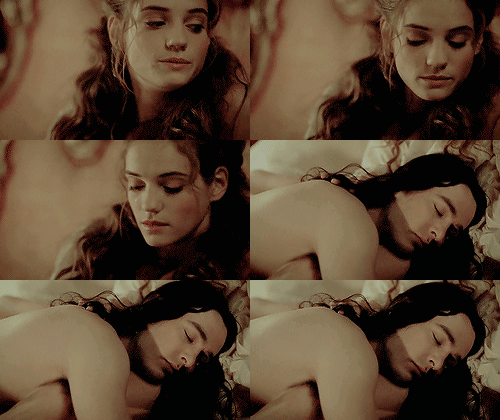
 She also lets her royal lover use her body as well as her mind. He sends her in a secret mission to England to ensure her brother’s support in France’s war against William of Orange. Although in real life, Minette did possess diplomatic skills, in the series she’s seen just like a talking doll delivering her lover’s words to her brother, the King of England. Daniel Lapaine as Charles II didn’t seem very bright either, so we can say “Versailles” did its best to show us the Stuarts as a family of dull morons.

Lesser Stuarts may prove to be more fetching
If the Stuart Kings prove to be less than appealing, we would have to look among their siblings to find stories deserving to be told, for example tragic Arabella Stuart, the Queen of Scots’ niece,  who is the protagonist of The Girl in the Glass Tower, Elizabeth Fremantle’s latest novel.

There is also James Stuart, Duke of Monmouth, Charles II’s illegitimate son who attempted to grab the throne from his uncle and namesake, and ended up losing his head. If you add that Monmouth could have been the real Man in the Iron Mask, you have plenty to work with.

The Duke of Monmouth
The current British monarch, Queen Elizabeth II can trace back her Stuart ancestry to Princess Elizabeth, daughter of the first King James. The Winter Queen, as she was known, could have been queen of England had the Gunpowder Conspiracy succeeded. She made a love match (a rarity in royal families of the time) to Prince Frederick of the Palatinate, became the mother of thirteen children, and was the grandmother of George, first Hanover king of England. Dear Lieselotte of “Versailles” fame was her granddaughter, too. Elizabeth did eventually rule Bohemia, part of modern Czechoslovakia. Alas, her reign was short and sad.
The Winter Queen

I’m fond of Elizabeth of Bohemia, but my favorite Stuart is her son, Prince Rupert of the Rhine, famed military man, inventor, artist, and rumor has it, wizard. He even had a magic dog that died fighting alongside his master. So, it is possible to sell the Stuarts to the public, but only looking beyond their dysfunctional kings. Do you have a favorite among that outlandish royal family?


Wednesday, June 7, 2017

What I learned in “The Tudors” and why “Wolf Hall” was a disappointment


Thanks to “The Tudors,” I learned three historical facts:  saintly Thomas More burned heretics, Thomas Cromwell was a man ahead of his time; and Anne Boleyn was a learned   woman who brought French chic to the coarse English Court. My greatest disappointment with “Wolf Hall” was that it completely overlooked Anne’s contributions, inflated and falsified More’s dark side, and failed to turn Cromwell into a sympathetic figure. Does that mean “The Tudors” is superior to “Wolf Hall”?

I closed my opening paragraph with a question that, hopefully, will generate an honest debate. Ever since “Wolf Hall” debuted in “Masterpiece Theater,” it is anathema to try to compare it to” The Tudors.” Michael Hirst’ script is pulpy, full of gratuitous sex and historical inaccuracies. “Wolf Hall,” on the other hand, may lack Showtime’s flamboyance, has almost no sex, no nudity, and it’s discreet and modest, but, by no means, it should be considered flawless.


Having missed “Wolf Hall” in 2015, I was happy to catch a recent rerun in PBS. Although not blind to the show’s merits (which I shall discuss below), I was distracted and annoyed by so much bias and imprecisions.  For that, let’s not blame the BBC, but the book they so carefully adapted. I was told that when it came to historical fiction, Dame Hilary Mantel was scrupulous both in her research and in veracity. Too bad she lets her prejudices overshadow such scruples.

It came as a shock to me that my admired Thomas More had been a heretic hunter and instrumental in the burning of at least six of them.  I learned this sad bit of history in the trashy ‘Tudors’, but the Showtime series also enlightened me about other aspects of More’s life.  Easily verified aspects such as his devotion to his Spanish queen, his love for his family, his struggles to uphold his principles in trying times. The moment Jeremy Northman’s character got to the block, I was all for him because I understood that, in the context of his times, he was not a bad man.


Historians feared that upgrading Cromwell from the villains 'pit would overshadow his deviousness and crimes. Yet “The Tudors” presented us with a scheming, ruthless Cromwell who was not entirely unsympathetic. Mantel’s Cromwell lacks the debonair energy that James Frain brought to his character in “The Tudors.” Frain’s Cromwell bubbled with zest, industry, and expectations for the many projects he had concocted. In “Wolf Hall,” Sir Mark Rylance portrays Cromwell as a collected and distant man who sort of sleepwalks through his evil times and the evil things he does. He only breaks down twice, when in presence of his wife’s corpse, and in his angry tirade provoked by Thomas More’s assertion: “Ï do no harm.”

As Emily Nussbaum noticed in The New Yorker, Sir Mark plays Cromwell as a man without illusions. There we have the first historical inconsistency. Mr. Secretary was anything but a man lacking in aspirations. Realist as he was, he could also afford to dream about his coming up in life and his role in shaping England’s history. His foremost dream was to implant a new, superstition-free, religion in the land.


Almost at the end of the Third Season of “The Tudors” there is a scene that proves my words. A servant has sneaked in Cromwell’s rooms to pilfer a pear. He is shocked to find his master immersed in prayer. Why is he not in a church? Mr. Secretary not only gives him the pear, but rewards the boy with an explanation that G-d is everywhere. One doesn’t need temples or priestly intervention to approach Him! At that moment, Cromwell’s faith is so potent and moving that one forgives him all past misdemeanors. And yet in Wolf Hall, Mantel has an exasperated Cromwell tell More when he notices how his nemesis feels too close to the Almighty: “You talk about your Maker as if he were some neighbor you went fishing with on Sunday afternoon.” Isn’t that the whole point of the New Faith? A more personal relationship with the Divinity?

The problem is that Mantel is both anti-Catholic and anti-religion so she downplays her protagonist’s reformism and religious convictions. She is not alone in considering that the Lord Chancellor’s faith can be a deficiency.  In a blog that compared “The Tudors” to “Wolf Hall,” the bloggers accused Frain’s Cromwell of being “a fanatic.” It’s a telling sign of the times we live that any person of faith should be branded “a fanatic.”

Wolf Hall’s Cromwell may not be a fanatic, but he is a cunning, vindictive person, one who’s actions are motivated by personal resentments. This Cromwell holds grudges against several people and he acts against them propelled by such bitterness. On those grounds, he has Anne Boleyn, the five men accused of being her lovers, and St. Thomas More (whom Cromwell resents since they were children) executed. But the More-Cromwell Feud (that has no historical foundation) will be discussed in another entry. First, I want to be objective and point out the show’s merits, and then go into The Bad and The Ugly in book and series.

Much has been said about the book’s anti-Catholic slant, but few have noticed another dangerous prejudice. There are no good women in this story! The author is so vicious to characters of her own sex that one could call her misogynist. She is particularly venomous in her creation of a despicable and unredeemable Anne Boleyn. Next to Mantel’s Anne, Philippa Gregory’s queen is St. Bernadette Soubirous.


THE GOOD
Damian Lewis as not-so-fat Henry VIII

Although he opted (like others had before him) to be a slim Henry VIII, Damian Lewis played a character remarkably closer to what the last Tudor king was in real life.  This Harry is not a cynical psychopath like Jonathan Rhys Mayer (in “The Tudors”,) neither is he a somber aloof tyrant like the one portrayed by Eric Bana in “The Other Boleyn Girl.” Damián’s Henry is affable, intelligent and somewhat vulnerable. On the second episode, he hands some coins to Cromwell for Wolsey-relief but whispers that he can’t give more because others won’t let him. There is a sense that he is a hesitant king,  that still cares for his adviser’s opinions, but who is not beyond charity and kindness.

Then, in the middle of the night, the king summons Cromwell. He’s had a bad dream and needs someone to holds his hand. And thus, the friendship begins. It’s almost biblical. Ahasuerus and Mordechai. Or is it Ahasuerus and Haman? Cromwell rises to the occasion and demands that Henry rules: “Now it’s the time for you to become the king you should be!” Really? Henry had been ruling for over fifteen years and so far, he had been doing a good job. It was only after Cromwell’s entrance in the picture that Harry became a jerk and that was not Mr. Secretary’s fault. Well, not entirely.

But the greatness of Damian’s performance lies in his character’s evolution. From the besotted king who confides to his secretary: “She (Anne) makes me shake!” and joyful father-to-be who hugs Cromwell after learning his wife is pregnant again, Henry evolves into a sneaky self-centered Queen of Hearts that demands the heads of all who crosses him. For once, there is no attempt to whitewash his character. In “Wolf Hall”, Henry is a beast willing to devour all who bother him: children, wives, friends.

Cromwell as a Ladies Man
Somewhere in “The Tudors,” James Frain bared his soul to his archfoe, the Duke of Suffolk, confiding that his enemies were wrong. Mr. Secretary had a heart, too much of it. In “Wolf Hall “I love to see how Sir Mark Rylance’s Cromwell puts that heart to work (and other parts of his body as well.) By the way Cromwell cries out over her corpse, he was madly in love with his wife Liz. He flirts up a storm with Mary Boleyn, talks about a mysterious Anselma — a past love— and indulges in a clandestine affair with his much-married sister-in-law. He even fantasizes about fondling Anne’s meager boobs!

All throughout, he silently pines for virginal Jane Seymour. Yes, the same one that married Henry the VIII. It is heart-rendering to see Cromwell facing the fact that his king is taking away the woman he loves. It makes you think that if he had spent less time plotting revenge and nursing childish grudges, he could have found happiness with Jane. Well, only in fiction because there is no historical basis for such a romance, but to me,  this is one legitimate creative license.


Sir Mark’s scene with newcomer Kate Phillips (who plays Jane) are a delight to see. He is warm, caring and almost paternal towards her. This attitude turns him into an endearing character. Jane, like most women in the show, can be true to herself when alone with the Lord Chancellor. On that note, Mary Boleyn pours out her heart to Cromwell, and even haughty Anne holds his hand and shows him her bare legs during her confinement.


Dame Hilary Mantel’s finest mastery lies in her depiction of Thomas Cromwell’s relationships with the other sex. With none of James Frain’s sycophantic graciousness, Rylance comes out as someone who understands women and is willing to help them. As caustic Lady Rochford mutters, he is “a good listener.” Sadly, the women in this tale are not as amiable as Good Tom.

THE BAD
Were There No Nice Women in Tudor England?
What makes Cromwell’s kindness towards women so extraordinary is that there are no sympathetic feminine roles in this story. The few nice girls are either children (Cromwell’s dead daughter) or low class:  his wife, Rafe’s wife, Crammer’s wife (the last two only appear in the book).  But even his sister-in- law,  whom he takes into his bed after his wife’s passing, is shown as an adulteress, who dreams her husband dead, and is willing to marry a forbidden man (in those days marrying an in-law was considered incest).  And not all humble women deserve good treatment from Mr. Secretary’s part.

Neither Cromwell nor Mantel have pity on Elisabeth Barton, the “Holy Nun of Kent,” a former serving girl famous from her visions. Mr. Secretary uses her for his purposes and has her executed without trial, failing to see her as what she really is, a deranged woman. To his eyes, a visionary who serves the nobility is a toadying lackey. Ironically, so is Cromwell and like Elisabeth Barton, he will also lose his head.

But it’s ladies of quality that get the worst press here. They are ambitious fools like Blessed Margaret Pole, or big- mouthed alcoholics like Lady Alice More. Mary Boleyn is a slut consumed by sibling- rivalry and her sister in-law, Jane Rochford (delightful to see Jessica Raines move so far from her angelic Jenny of “Call the Midwife,”) is a spiteful bitch.

 Katherine of Aragon, the most tragic character in this tale, is depicted as a superior snob who introduces Cromwell to her daughter as: “This is Mr. Cromwell. He used to be a moneylender.” Even sweet Jane Seymour, whom Cromwell loves from afar, is a shrinking violet who pretends to be much more gullible than she is, and can leave doodles of headless corpses on the bed of her tormenting mistress. But it is that mistress, Anne Boleyn, who gets the worst and mostly unjust press in the book and the series.


THE UGLY
No other historical figure in Wolf Hall (aside from Thomas More, of course) gets butchered as Anne Boleyn does. Remembering the outrage at Anne’s portrayal in The Other Boleyn Girl, it’s amazing that nobody has complained about Hilary Mantel’s distorted interpretation of King Henry’s second wife. Dame Hilary considers the real Anne Boleyn a self-serving woman who used her sexuality to get ahead, and she describes her as such.


Modern historians do not share Mantel’s narrow-minded views. And certainly, that is not the Anne Boleyn played by Natalie Dormer in “The Tudors.” Dormer’s Anne is an ambitious and manipulative temptress. but Sir Thomas Wyatt’s muse is much more than a mere seductress. Natalie told Professor Susan Bordo that she had read plenty on Henry’s second queen and wanted to incorporate her knowledge to her character.


 Although, Michael Hirst was bent into The Other Woman stereotype, Natalie Dormer managed to pull Anne away from the femme fatale niche and brought us a devout reformer, an intellectual who guided Henry’s readings, a patron of poets and musicians, and a kind queen who felt that the Church’s confiscated riches belonged to the poor not to Henry or Cromwell.


Hilary Mantel does not believe in that Anne. On that note, she invents a queen of phony, an affected little bitch that sports a fake French accent (she insists on calling the Lord Chancellor, “Cremuel”) someone who is cruel to her maids, and lethal to her enemies. Poor Claire Foy, aside from wearing ill-fitting clothing, her Anne wears a perpetual scowl. Anne’s contemporaries, even her enemies, commented on her unusual vivaciousness and wit. Alas, Foy’s pouting creature is not one to provoke desire.

As depicted in “The Tudors,” Cromwell and his queen worked together to reform England and its church. Their dynamic has captured the fandom imagination who express the shipping in all forms of fanfiction. But just as Dame Hilary has chosen to ignore all good about Queen Elizabeth’s mother (I have just read a great article that identifies Anne with Dame Hilary’s mother!), she has her Cromwell loathing Anne and The Boleyn Family.

Both Edward Hall’s Chronicles, and Eustace Chapuys’ reports to his emperor, describe Anne constantly railing against Princess Mary and Catherine of Aragon. She did dress in yellow and threw parties to “celebrate” the Spanish queen’s demise. So, I’m inclined to believe what Wolf Hall and “The Tudors” tell us about Anne’s hatred for her husband’s ex, and her fears that “bastard” Mary would rob Elizabeth of her throne. Perhaps she resented More’s commitment to Catherine, but I don’t believe that like Mantel’s Anne, she played a pivotal role in his martyrdom.


In real life, Anne and Cromwell had a fallout over something Dame Hillary opts to forget: Cromwell’s greed. Anne was shocked to discover that the confiscated gold from the dissolved abbeys was lining her husband’s and Mr. Secretary’s pockets. She demanded it should be used for charity. When Cromwell refused, Anne had a priest preach against Mr. Secretary comparing him to biblical Haman. It was then that Cromwell decided to bring down the queen and her family. But Wolf Hall disregards these historical truths and has Anne and Cromwell fighting over something as bizarre as…Mary Tudor.


The Strange Case of Princess Mary and her Evil Stepmother
Wolf Hall presents us with a disturbing and off-the- wall relationship between Lord Chancellor and Lady Mary Tudor. One of the (obviously trumped out) charges against Thomas Cromwell was his intention to marry Henry’s eldest daughter. Funny, because Mary and Cromwell were not even friends.  After Anne Boleyn’s execution, Cromwell corresponded with Lady Mary to convince her (he failed just like with More and Catherine of Aragon) to take the accursed Oath recognizing Henry as the head of Catholic Church. After being rebutted once too many, Mr. Secretary lost composure and wrote in anger to the Princess calling her “the most obstinate of women!” Hardly the road for married bliss.

In Wolf Hall, Cromwell meets Mary while visiting her mother. He finds her suffering from menstrual cramps, and drags a chair for her to sit down. That bit of kindness prompts the future Bloody Mary to confide to this stranger her opinions of his father’s mistress. Later, he tries to make Mary’s life less miserable by arranging a dynastic marriage for her.

Henry, who acts like he hates a daughter he once loved, berates Cromwell and accuses him of getting too big for his breeches. Anne, of course, fuels the fires. She truly hates Mary and demands Cromwell to compromise her stepdaughter. After all, “She likes you!” Ohhh, is this Queen Ravenna talking about Snow White? Not even gossipy Chapuys imagined Anne reaching this extent of hatred for her husband’s daughter. “Those are not my methods,” Cromwell answers coldly. His interest in Mary will lead to his final bout with the queen.


By the end of Chapter Six, the king has received a bad blow while jousting. Fearing his imminent death, Cromwell sends for Princess Mary, obviously to have her crowned. On hearing this, Anne goes bonkers. Why such a treacherous act when she was pregnant and Elizabeth was the obvious choice to inherit her father’s crown? As this never happened in real life, Mantel’s Cromwell comes up with the lamest of excuses. He can’t rely on unborn babes and infants. Would the real Cromwell rely on Mary, a girl that had every reason to detest him, a devout Catholic, the emperor’s cousin, someone that stood against everything he believed and fought for? Obviously not, but that is Dame Hilary’s way to explain Cromwell’s betrayal of Anne.

All I hope, is that in the last book, Dame Hilary continues playing with this impossible but titillating friendship between such unlikely mates.  Meanwhile there is plenty of fanfiction (in video form) created by those who ship Mary-Cromwell.


In my next entry, I hope to discuss the totally fictitious feud between both Lord Chancellors, show how real-life Thomas More had nothing to do with Mantel’s character, and how by placing Cromwell on an altar, Dame Hilary distanced him from the riveting man he really was.